Address
304 North Cardinal St.
Dorchester Center, MA 02124
Work Hours
Monday to Friday: 7AM - 7PM
Weekend: 10AM - 5PM

Address
304 North Cardinal St.
Dorchester Center, MA 02124
Work Hours
Monday to Friday: 7AM - 7PM
Weekend: 10AM - 5PM


Free traffic sources for affiliate marketing may sound like something that only matters to people trying to make money online, but traffic is the lifeblood of just about every business.
Think about the products and services you use every day. Food, household products, cars and transportation, plumbers, HVAC companies, restaurants—you name it. Before any of those businesses can make a sale, they first have to get their product or service in front of people.
That’s why businesses advertise.
They use television and radio commercials, billboards, newspapers, flyers, signs, direct mail and even word of mouth. The methods may be different, but the goal is basically the same: get people’s attention and give them a reason to take a closer look.
Online business isn’t any different.
You can have a great affiliate product, a well-designed website or an offer you genuinely believe can help someone. But if nobody ever sees it, it’s going to be pretty difficult to earn anything from it.
That’s where traffic comes in.
And when you’re trying to build something online without spending a lot of money on advertising, free traffic sources for affiliate marketing can sound like the perfect answer.
I’ve used plenty of them myself.
But there’s something I learned along the way that I didn’t really think about when I first started:
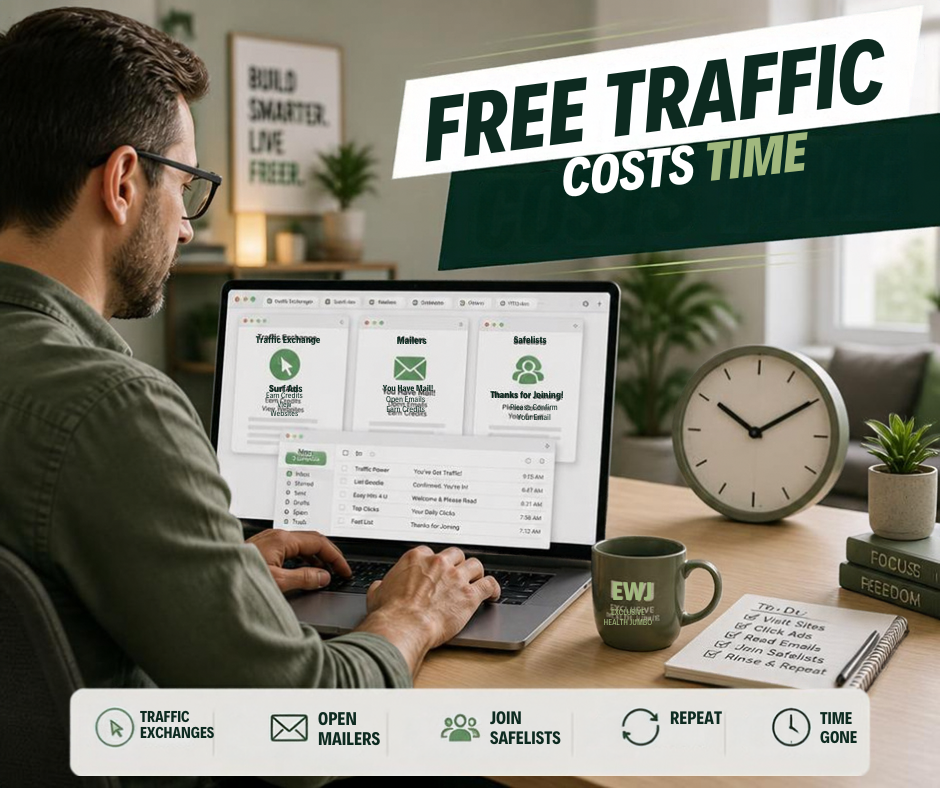
Free traffic isn’t always free.
You may not be paying for every visitor with money.
But you could be paying for that traffic with something just as valuable—your time.
When people talk about free traffic online, they usually mean traffic they aren’t paying for directly.
Traffic exchanges are one example. You can view other members’ websites to earn credits and then use those credits to have other members view your site or offer.
But you don’t necessarily earn one credit for every site you view.
Traffic exchanges use what’s commonly called a surf ratio. A 1:1 ratio means you view one site to earn one credit. With a 2:1 ratio, you may need to view two sites to earn one credit. At 3:1, it can take three views to earn that same credit.
The exact ratio depends on the traffic exchange and your membership level. Free members may earn credits more slowly than upgraded members.
Mailers and safelists use credits too, although they work a little differently.
Instead of surfing websites, you may earn credits by opening an email and visiting the advertiser’s page. Depending on the mailer and your membership level, an email might be worth 10 credits, 25 credits or considerably more.
Those credits can then be used for advertising. On some sites, credits determine how many members you can mail to. Other sites may use them for banner or text-ad impressions, and some provide additional mailing options that don’t require credits.
The exact numbers aren’t really the important part.
The important part is what you have to do to earn them.
Whether you’re viewing one page, two pages or three pages to earn a traffic credit—or opening emails and visiting advertised pages to build mailing credits—you are exchanging something for that traffic.
You are exchanging your time.
And when you’re only using one or two sites, that may not seem like a big deal.
But what happens when you’re using 10? 25? 50? Or more?
That’s when “free traffic” can start becoming pretty expensive in a completely different way.
The credits you earn aren’t always limited to sending visitors to one website.
Depending on the traffic exchange, mailer or safelist, you may also be able to earn or receive credits for banner ads, text ads and sometimes other forms of advertising such as login ads.
Many sites also give new members a promotional code when they join. Entering that code may give you a starting package of advertising credits so you can begin testing the site without spending money.
But every site is different.
One owner might include website and banner credits. Another might include text ads, mailing credits or additional advertising. The amounts and types of credits are determined by the individual site, so there isn’t one package that applies everywhere.
You’ll also often see something called an OTO, or One-Time Offer, when joining a new site.
An OTO may offer an upgraded membership, a larger package of advertising credits or additional features at a discounted price. Some of these offers can be a very good deal if you can afford them and they fit what you’re trying to accomplish.
But I don’t upgrade simply because something is being offered at a discount.
Before I spend money on any program, I ask myself two questions:
Can I afford this without creating a hardship?
Will it help me reach my ultimate goal?
The first question is usually pretty easy to answer.
The second can be much harder when you’ve just joined a new traffic site because you haven’t had enough time to see how that traffic actually performs.
That’s why I like to test whenever possible.
Getting visitors is one thing. What those visitors do after the click is what I’m really interested in.
One example of the many mailer sites I use is European Safelist.
Like many safelists, you can join for free and earn advertising credits by opening emails and visiting other members’ offers. Those credits can then be used to send your own advertising.
European Safelist also has a sister site called European Safelist Viralmailer. The two sites use the same login, but they give you another place to advertise and another potential source of traffic.
Something that caught my attention was the upgrade structure. An upgraded membership carries over to both sites, so you aren’t paying separately to upgrade each one.
At the time I’m writing this, I’m still using the free membership while I decide whether to test one of the paid levels. The Pro level I’m considering is only $7 a month.
But it has to prove itself first. As a free member, this is where tracking your advertising plays a major role.
Seven dollars may not sound like much, but I don’t look at an upgrade simply as “only $7.
With other monthly business expenses, and in my case once that $7 is converted to Canadian dollars, it’s closer to $9 or $10 a month. Add enough small monthly expenses together and they stop being small.
That’s why I come back to the same two questions before adding another expense:
Can I afford it without creating a hardship?
Will it help me reach my ultimate goal?
In this case, the first answer may be yes. The second one still needs to be tested.
That’s why, if I upgrade, I’ll track the traffic and what happens after the click. If the additional exposure produces worthwhile results, then the monthly cost may make sense. If it doesn’t, being inexpensive isn’t a good enough reason for me to keep paying for it.
Another reason European Safelist caught my attention is List Hoopla. I use List Hoopla as another way to see which mailers and safelists are currently active and worth taking a closer look at. At the time I’m writing this, European Safelist is included in List Hoopla’s first group of recommended email advertising sites. That doesn’t mean the traffic will automatically work for my offer, but it gives me another reason to test it and track my own results.
That is one of the biggest lessons I’ve learned about both free and paid traffic:
The price tells you what something costs. The results tell you what it’s worth.
The real challenge with free traffic sources for affiliate marketing isn’t necessarily using one traffic exchange, mailer or safelist.
It’s what happens when you start using a lot of them.
One site may only take a few minutes. You open some emails, earn some credits, send your advertising and move on.
Add another site and you do it again.
Then another.
Before long, you may be logging into dozens of different sites, checking when you can mail again, earning credits, setting up ads and trying to keep track of what you sent and where you sent it.
I’ve used enough of these sites to know that free traffic can bring visitors to an offer.
I’ve also learned that getting visitors isn’t the only thing that matters.
I want to know which traffic sources are producing real visits, which ads are getting a response and, most importantly, what those visitors do after they click.
That’s why tracking has become such an important part of how I advertise.
Without tracking, I could spend hours earning credits and sending ads without really knowing whether all that time is helping me move closer to my goal.
And that’s where the meaning of “free” starts to change.
I may not be paying for every visitor with money, but I’m still paying with my time.
Technically, it can be.
You can join many traffic exchanges, safelists and mailers without paying for an upgraded membership. If you’re willing to earn the credits yourself, you can advertise without buying every click or visitor.
But that doesn’t make the traffic cost-free.
Your time has value too.
That’s probably the biggest thing I wish I had understood earlier. I used to look mainly at whether something required money. Now I also look at how much time it requires and what I’m getting back for that time.
That doesn’t mean I’ve stopped using free traffic.
I haven’t.
It means I’m trying to use it more intelligently.
I track what I can. I test before assuming an upgrade is worthwhile. And I pay attention to what happens after the click instead of judging an advertising source simply by how many visitors it sends.
But that leads to another problem.
What happens when you’re trying to manage dozens—or even 100+—of these traffic sources?
Doing all of that manually can become a job of its own.
In Part 2, I’ll show you the time-saving approach I use and why I eventually decided my time was worth something too.
Affiliate & Referral Disclosure
Some links on this page may be affiliate or referral links. This means I may earn a commission or receive another benefit if you join or make a purchase through one of my links, at no extra cost to you.

