Address
304 North Cardinal St.
Dorchester Center, MA 02124
Work Hours
Monday to Friday: 7AM - 7PM
Weekend: 10AM - 5PM

Address
304 North Cardinal St.
Dorchester Center, MA 02124
Work Hours
Monday to Friday: 7AM - 7PM
Weekend: 10AM - 5PM


Free vs. paid traffic for affiliate marketing sounds like a simple choice until you actually start trying to get visitors to your offers.
When I first started promoting online, I spent a lot of time clicking ads, earning credits, mailing safelists, and trying different ways to get people in front of my offers. Some of those methods worked better than others, but eventually I realized I was asking the wrong question.
Instead of asking, “How can I get more traffic?” I needed to ask, “What is this traffic actually doing for me?”
That changed the way I look at both free and paid traffic for affiliate marketing.
Today, I use a combination of the two. Free traffic helps me promote without constantly spending money, while low-cost paid traffic can keep visitors coming when I’m working on other parts of my business—or simply away from the computer.
Neither one is automatically better. What matters is where the traffic goes, whether I can track it, and what happens after the click.
In this article, I’ll show you how I use both, what I’ve learned from tracking the results, and why finding the right balance has saved me a lot of time.
One thing I’ve learned is that “free traffic” still has a cost: time.
Safelists, mailers, traffic exchanges, and other credit-based advertising can send visitors without charging me for every click. I still use those methods.
But earning credits, sending mailings, and managing multiple traffic sources takes time. If I’m spending hours generating traffic manually, that’s time I’m not spending writing content, improving my pages, following up, or looking at the numbers.
That’s one reason I stopped thinking that all of my traffic had to come from one method.
I don’t look at free traffic and paid traffic as competitors. They serve different purposes in my business.
Free traffic gives me ways to promote without paying for every visitor. That includes some of the mailers and traffic sources I use, along with content here on Earning With Jason and the platforms where I share it.
Paid traffic gives me another option when I want visitors going to a page without having to sit at the computer earning advertising credits first.
But there’s something important I’ve learned:
Paying for traffic doesn’t automatically make it good traffic.
I’ve seen plenty of clicks that looked good on a counter but didn’t accomplish much beyond that.
This is where tracking became important for me.
I use LeadsLeap to track many of my links and traffic sources. Instead of looking only at the total number of clicks, I can get a better picture of what is actually happening.
I want to know things like:
Without tracking, it’s easy to keep spending time—or money—on a traffic source simply because the click count looks impressive.
A lot of clicks don’t necessarily mean a lot of results.
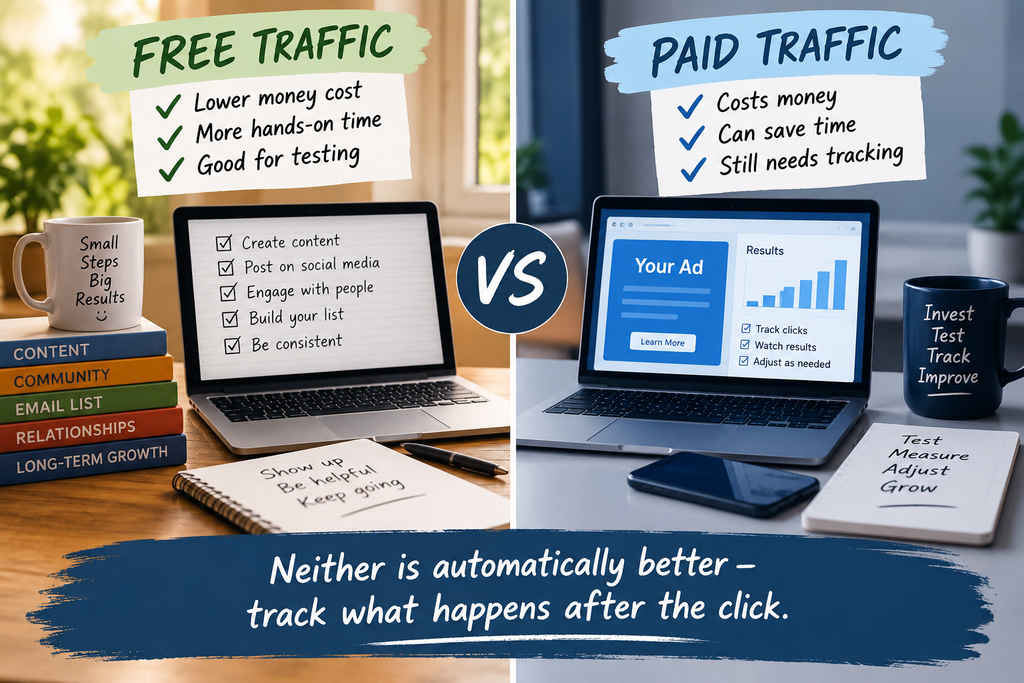
I haven’t abandoned free traffic either.
Free traffic gives me opportunities to test messages, landing pages, subject lines, and offers without increasing my advertising budget every time I want to try something.
The tradeoff is that some free traffic methods require more hands-on work.
That’s why I don’t believe the answer is spending all day chasing every possible free click.
I’d rather use the sources that make sense, track what they produce, and put more attention into the ones that show promise.
Traffic is only the beginning.
If someone clicks and then disappears, the size of the traffic number doesn’t mean very much.
That’s why landing pages, list building, tracking, and follow-up have become just as important to me as the traffic source itself.
I’ve been working toward connecting those pieces so they support one another instead of managing a collection of unrelated programs.
That has been one of the biggest changes in how I approach my online business.
If you recommend a product, service, or online business and you could earn money when someone buys or joins through your link, you should let people know. This is called an affiliate or referral disclosure. The FTC provides guidance explaining how these disclosures should be handled.
I use LeadsLeap to track many of my links and traffic sources so I can see more than just a click count. It also includes tools for building landing pages, collecting email subscribers, and following up with them.
You can start with a free LeadsLeap account and explore the tools for yourself.
I still use both free and paid traffic.
The difference today is that I’m much less interested in how many clicks I can generate and much more interested in what those clicks actually do.
Free traffic can save money but cost time. Paid traffic can save time but cost money. Neither one guarantees leads, sales, or commissions.
For me, the better approach has been finding a balance: use traffic sources I can manage, track what happens, build around assets I control, and keep improving based on what the numbers actually show.
That’s a lot smarter than spending the entire day clicking just so I can say I got more traffic.
If you’d like to follow my journey while making progress on your own, I’d love to have you join my newsletter.
You’ll receive new blog posts, beginner-friendly marketing tips, and practical lessons that can help you as you continue building your own online business.
Affiliate & Referral Disclosure
Some links on this page may be affiliate or referral links. This means I may earn a commission or receive another benefit if you join or make a purchase through one of my links, at no extra cost to you.


[…] also why I stopped looking at traffic as simply “free” or “paid.” In Free vs. Paid Traffic for Affiliate Marketing: What I Actually Use and Why, I explain how I look at both now and why neither one is really […]